Former home-work house ir. Abe Bonnema
Hurdegaryp
One of the many locations in Hurdegaryp with a historical story
Take a look

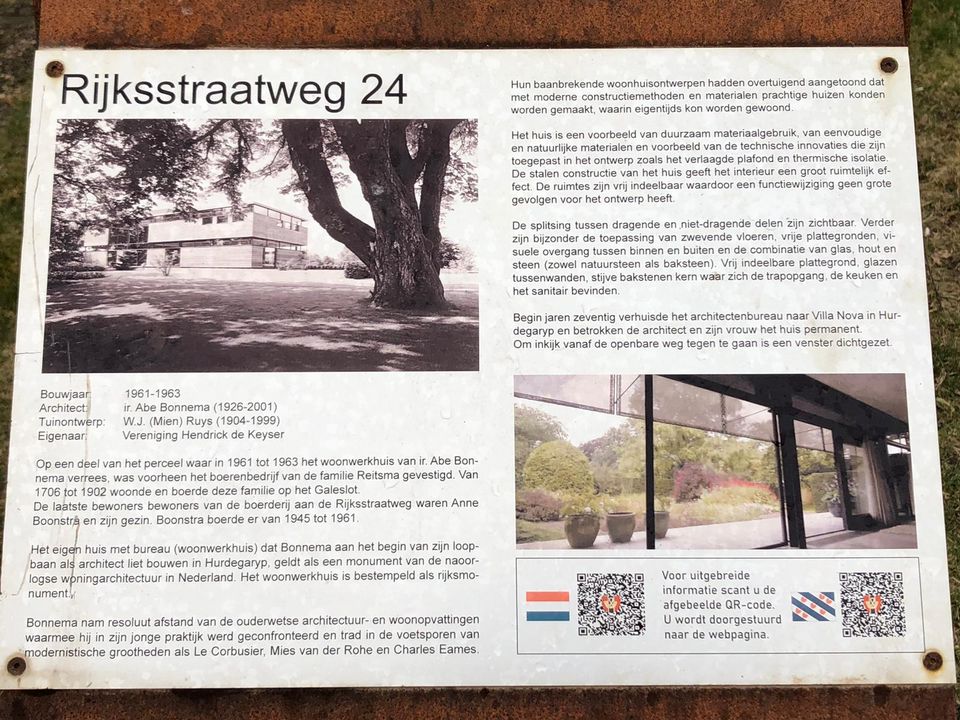
On a part of the plot where the living-working house of Abe Bonnema was built in 1961 to 1963, the farm (cattle farm) of the Reitsma family used to be located. From 1706 to 1902, this influential family lived and farmed on Galeslot. The last residents of the farm on the Rijksstraatweg were Anne Boonstra and his family. Boonstra farmed there from 1945 to 1961.
The house with office (live-work house) that Bonnema had built in Hurdegaryp at the beginning of his career as an architect is considered a monument of post-war housing architecture in the Netherlands. The live-work house has been labeled as a national monument.
Bonnema resolutely distanced himself from the old-fashioned architectural and living views he was confronted with in his young practice and followed in the footsteps of modernist greats such as Le Corbusier, Mies van der Rohe and Charles Eames. Their pioneering house designs had convincingly demonstrated that modern construction methods and materials could be used to create beautiful houses in which contemporary living could be done. The house is an example of sustainable use of materials, of simple and natural materials.
With this radical design, Bonnema accurately made it clear what he stood for as an architect. The house is a paragon of post-war modernism and an example of the pragmatic functionalism he stood for: the building as a commodity.
In essence, the building is a rectangular box with floors and a concrete roof. A series of steel portal trusses keeps everything upright, helped by a masonry core for the required rigidity. The facades are separate from this construction and do not carry any burden. Bonnema has made use of the freedom that this offers by installing band windows around the roof and storey floor. The rest is a play of open and closed surfaces, with mainly glass on the west side and a lot of untreated wood on the more closed east side.
The house is an example of the new thinking about the use of space. The split between load-bearing and non-load-bearing parts is visible. The steel construction of the house gives the interior a great spatial effect. The spaces can be freely arranged, so that a change of function does not have major consequences for the design. Also special are the use of floating floors, free floor plans, visual transition between inside and outside and the combination of glass, wood and stone (both natural stone and brick). The house is an example of sustainable use of materials, of simple and natural materials and an example of the technical innovations that have been applied in the design such as the suspended ceiling and thermal insulation.
In the interior, which can also be freely divided, domains have been demarcated for the various functions with thin walls and space-separating elements. Bonnema did not strictly distinguish between living and working. In addition to the drawing room for the architects, the only bedroom of the house was located on the upper floor. Downstairs, in addition to the representative living room that Bonnema called 'reception room', there was a meeting room and a workspace, among other things.
The building was designed in the early sixties as the office of the Bonnema Architectural Firm and where it was also possible to spend the night. Until the seventies of the twentieth century, the building was used as a studio by the architectural firm Bonnema. On the first floor there were a few living quarters where the architect (and his wife in the weekends) stayed.
The surrounding garden, a design by Mien Ruys the size of a small park, is always close by thanks to the transparent facades. During the construction, a number of old trees present on the site were taken into account. Like the old chestnut that Gerrit Vlaskamp*) probably had planted there in 1867. The tree was killed by the summer storm on Saturday, July 25, 2015 and partially fell on the neighbor's house. The Collicchia family has always been afraid of that. The family has lived next to the tree for 40 years and has always said that it was not safe for the chestnut tree to still be there. There have been lawsuits over the old tree between Abe Bonnema and the Collicchia family. Bonnema then usually had to have overhanging branches sawn from the tree.
In the design, Mien Ruys has made use of the elements that often recur in her work, such as the connection between house and garden, hedges, height differences, tiles, poles as boundaries, sharp corners and a pond.
House and garden form an interplay between the whimsical natural and the straight artificial design. The house and garden form a unity through the visual transition of inside and outside.
In the early seventies, the architectural firm moved to Villa Nova at Pôllesingel 2.
Then the architect and his wife Marcella moved into the former live-work house on the Rijksstraatweg permanently.
Abe Bonnema died on August 9, 2001. The house has since had several residents. The current owner of the building - the Hendrick de Keyser Association - rents it out.
Here you will find Former home-work house ir. Abe Bonnema
Rijksstraatweg 249254 DJ Hurdegaryp Plan your route to Former home-work house ir. Abe Bonnema